Barony of Thornton
Barony and Castle of Thornton
By Jim Strachan, MBA, FSAScot (Printed
August 2005, Last Revised 9 April
2023)
Clan Strachan Scottish Heritage Society, Inc.

Figure 1: Dennis Strawhun and Jim Strachan (2005)
Founders
of the Clan Strachan Society at Thornton Castle
There are various claims regarding how the Strachan family came into possession of the barony of Thornton. There are even more conflicting claims regarding the family's genealogy in subsequent centuries. Indeed, little can be afforded to the accuracy of Strachan of Thornton's early genealogy due to the inability to confirm various claims in Playfair's Baronetage (1811), which itself is said to be based on family oral tradition and frequently unsupported by grants, charters, or other supporting documents. McFarlane's Genealogical Collections, p. 265, is little better, while both volumes of Rogers, "Memorials of Strachan and Wise" (1873 and 1877) incorporate notoriously inaccurate information based upon both Playfair and McFarlane accounts. [source] Rogers' Memorials of Strachan and Wise is frequently taken out of context. The "book" is nothing more than a special pleading by the Wise family to acquire the Strachan of Thornton Baronetcy of Nova Scotia after the family had gone extinct in the male line.

Rogers
Memorial of Strachan and Wise (1873)
Claims these
are the arms of Admiral Sir Richard John Strachan, Bt.
Sir
Richard never filed a petition for arms in Scotland, England, Ireland,
or Wales
Rogers did not include these arms in his second
edition published in
1877
Regarding the Baronetcy, during the 2014 Clan Strachan Family Convention, David Sellar, Lord Lyon King of Arms, remarked in a letter dated 22 July 2010 to the author: "The history of the Strachan baronetcy of Thornton after its [second] holder who died c. 1659, "Seems to be extraordinarily convoluted with a multiplicity of soi-disant claimants." The author might add, more directly, that the holder of the baronetcy on multiple occasions had an extraordinarily doubtful claim, and the genealogical line arguably failed as early as 1659.
The earliest mention of Strachan in the Mearns is in a charter dated 1365. David II granted Alexander de Strathechin the lands of Lower Morphie in Kincardineshire (RI, 34-10; and H&G, 1874: 304). However, the territorial designation 'de Thornton' is not mentioned in the grant. Contrary to accounts provided in Playfriar's and Genealogical Collections, the first documented account of Strachan of Thornton is in a charter dated 1429, and any earlier date of the Strachan family being associated with Thornton estate is unconfirmed and therefore speculative (BR, nos 30 and 61).
The following should not be considered a complete genealogy of the family.
For those interested in a full genealogy, listing of Armorial Bearings, and detailed information about this family, it is available in the book, CLAN STRACHAN: Strachan of Thornton (1429-1854).
About Thornton Castle
Situated between Laurencekirk and Fettercairn, in the Howe of the Mearns, Thornton Castle is located immediately off the B9120 which itself is west of the A90). A must see for all Strachan clansfolk, this castle is beautifully maintained.
A visitor approaching the north-west front of the castle by this avenue will see on the left a squat round tower carrying the arms of the Strachans of Thornton and shot holes commanding the front elevation; the base of this tower, constructed of great whin-stone boulders, is a survival of an earlier building which stood on the site and extended over part of the gravel forecourt in the 14th century.

Thornton Castle (2005)
To the right is a four storey keep dating from 1531, though earlier work is incorporated. Nigel Tranter, who writes so knowledgeably about Scottish castles, describes Thornton ("The Fortified House in Scotland" Vol. iv, published by Oliver & Boyd, Edinburgh, 1966) as "a fairly small but excellently well-preserved example of a fortalice of the late 15th or early 16th century," and the keep as "an L-shaped structure of main block and stair wing, rising four stories to a crenellated parapet with open rounds at the angles, carried on a chequered corbel table. The parapet walk, drained by the usual cannon-like spouts, continues around the building, and projects as a half-round to give access past a free-standing chimney-stack on the east front."
On the 1st floor of this keep the stone walls of the former great hall, now oak paneled, carried some ancient mural paintings and in one of the deep window recesses a small hinged panel can be opened to disclose a tempera portrait with the inscription "Dame Elizabeth, Lady of Thornton." This was Elizabeth Forbes, wife of Sir James Strachan of Thornton, to whose memory there was an elaborate memorial in the Thornton aisle in the Marykirk parish church and who died in childbirth in her 25th year in 1661.
A window lintel above the present entrance bears the date 1662 but a stone achievement below this was added by Sir Alexander Strachan soon after his appointment as one of the 3 original baronets of Nova Scotia in 1625. That the lower part of this middle section of the castle (which is formed of barrel-vaulted apartments supporting the living rooms above), is of an earlier date, was confirmed when in 1974, the work of conversion of a former butler's pantry for use as an Estate Office revealed the wide stone hearth and fireplace of the kitchen which served the great hall in the 16th century keep (known as the 'Strachan Fireplace').
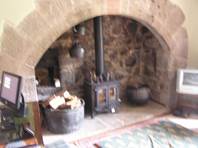
The 'Strachan' Fireplace
The garden front, with its square tower, is a mid 19th century addition and the large room at the base of the keep and the stained glass windows on the south-east front were added by Sir Thomas Thornton, great grandfather of the present laird (see below):
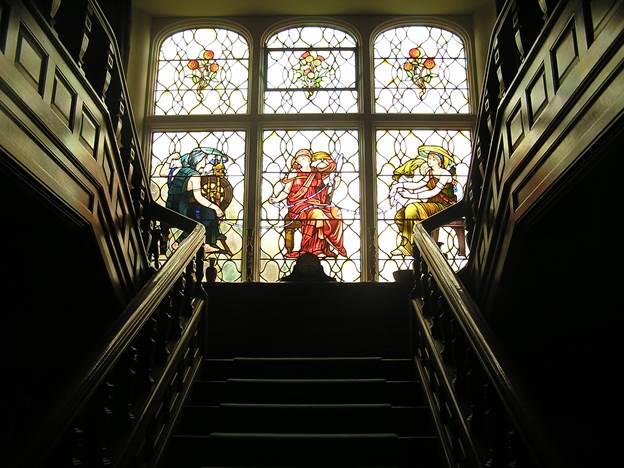
Stained Glass, added by Sir Thomas Thornton
Early photographs show that the exterior of the castle, with the exception of the battlements and corbelling and the massive buttresses, was at one time faced in white. Today the stonework, with its blue and grey mountain boulders and the contrasting pink of the sandstone, can be seen in the warmth of its original texture.
The parks in front of the castle and the gardens, now much reduced in size, are studded with fine old trees notable among which are two ancient yews reputed to be over 600 years old, and planted by the Strachans of Thornton.
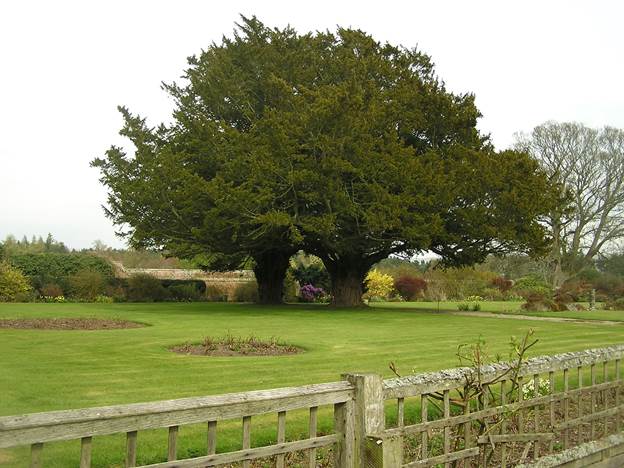
The yew trees, like the ones seen here, were used in the manufacture of long bows, due to the strength of the wood.
As mentioned previously, the castle was remodeled in the 19th century. However, further alterations and additions were made later. The basement is vaulted, the turnpike stair wide for the period. The Hall, on the first floor is now paneled but bears traces of tempera painting behind.
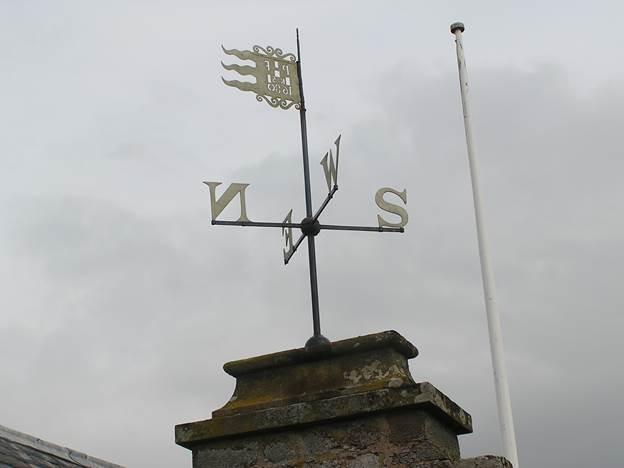
Thornton Castle - weather-vane bears the date of 1680
A weather-vane bears the date of 1680, and sits atop the newer square tower.
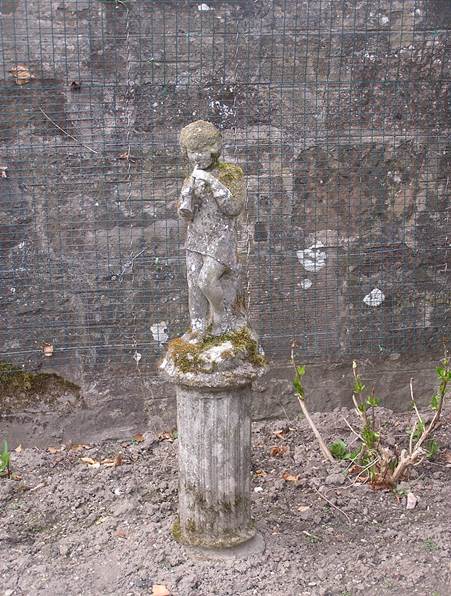
Small Statue located in the garden of Thornton Castle
After the Strachans, the property would eventually pass from the Forbes to the Fullartons for three generations, then to Lord Gardenstone, and in the 19th century to the Crombies, who did much alteration. In 1893 the late Sir Thomas Thorntonbrought the name back to the property, by purchase.
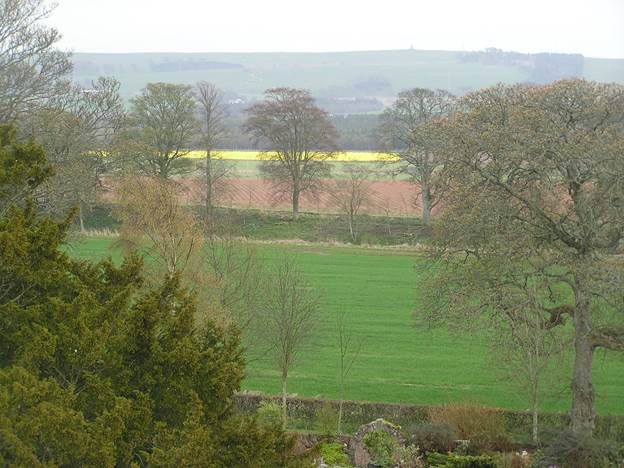
Thornton Castle is today located on approximately 1700 acres. The estate is absolutely beautiful, and contains a lovely daffodil field seen above in the distance. The above picture was taken from atop the square tower, and the daffodils of the Thornton estate can be seen in the distance.
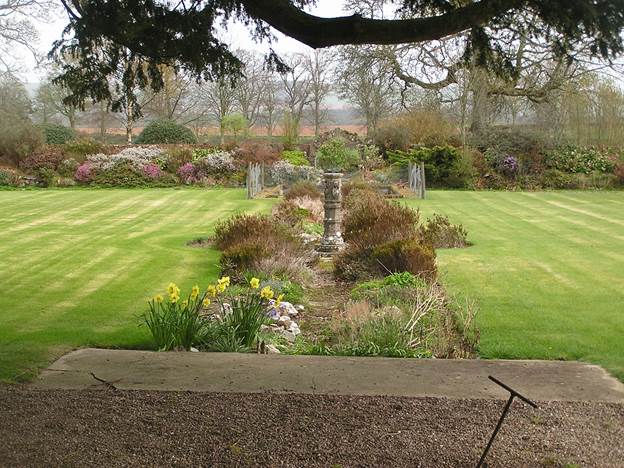
Like many castles and estates in Scotland, the current front entrance to the castle used to be the rear, and visa versa. The following picture was taken in the now 'backyard' of the home, and shows what the entry to the keep used to look like. If you notice, the branches of the old Strachan yew trees are visible at the top of the picture.
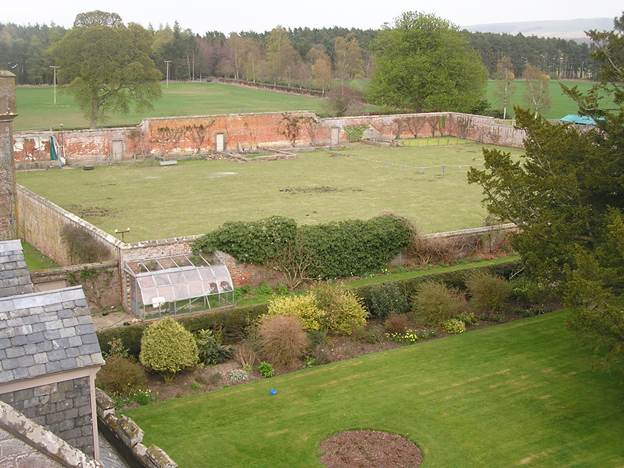
ictured here is the NE rear of Thornton Castle. Against the back wall, you'll notice a square foundation. These are the foundations of the old green house, which was used (and perhaps built) by the Strachans of Thornton. They were recently discovered, and subsequently un-covered by the Thornton-Kemsleys.
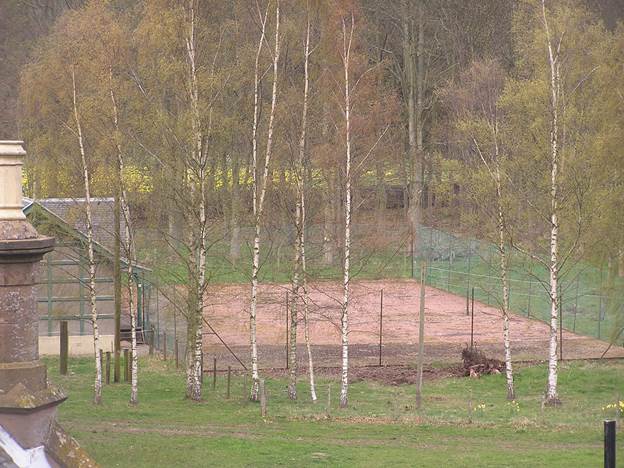
Alexander Crombie's son and his heir the fourth Alexander Crombie of Thornton, known as 'Joe' to his friends, and Joe's younger brother Francis rests the credit of introducing to Scotland the game of Rugby football which they had learnt at Durham School in 1852-53 six years after the codification of the laws of the game as played at Rugby.
It was the Crombies who created the cricket park - still so called though long since farmed - between the Black Burn and the East Drive and built the fine pavilion which, used initially for country house cricket, has been the scene of many family festivities and tenantry parties, accommodated families of evacuees during the second World War and more recently, a children's play ground (pictured above).
On this ground in August 1882 Colonel H.W. Renny-Tailyour of Newmanwalls, a Scot who played cricket for Kent and the Gentlemen of England, scored 140 runs in a record second wicket partnership of 370.
* * * * * * * * * *
Special thanks to Griselda Thornton-Kemsley and the entire Thornton-Kemsley family for their hospitality in welcoming us to Thornton, and providing a personal tour of Thornton Castle.